

@atlwarehouse 6 warehouse fires in the last 3 days #warehousefires #warehousefire #warehouse #atlantawarehouse ♬ original sound – ATL Warehouse
Just after midnight on April 7, a massive fire tore through a 1.2‑million‑square‑foot Kimberly‑Clark distribution center in Ontario, California. Within hours, a 29‑year‑old warehouse employee was arrested—and the videos he allegedly posted online revealed a motive far more disturbing than a faulty electrical wire: “All you had to do was pay us enough to live.” Over the next three days, five more warehouse fires erupted across the globe: a suspicious blaze at a trash transfer station in Georgia, a five‑alarm fire in a Queens warehouse, a fatal cold‑storage fire in South Korea that claimed two firefighters’ lives, and at least two additional warehouse fires in Asia and Europe that remain under investigation. In total, the six fires caused hundreds of millions of dollars in damage, several injuries, and at least two deaths.
While investigators have not linked every incident directly to labor disputes, the Ontario case has opened a window into a silent epidemic: the rising link between chronically underpaid warehouse workers and catastrophic workplace destruction. As one business analysis put it, “the living wage may also function as a hard security and risk management variable.” This article examines how low pay fuels unsafe conditions, why worker desperation is becoming a corporate security threat, and what the future holds if warehouse wages continue to lag.
@atlwarehouse Atlanta, Queens, Bakersfield, Ontario. I’m starting to lose track. “Many people are saying” … Only living wages can prevent warehouse fires‼️ #warehousefires #warehousefire #warehouse #atlwarehouse ♬ losing – Lonnex
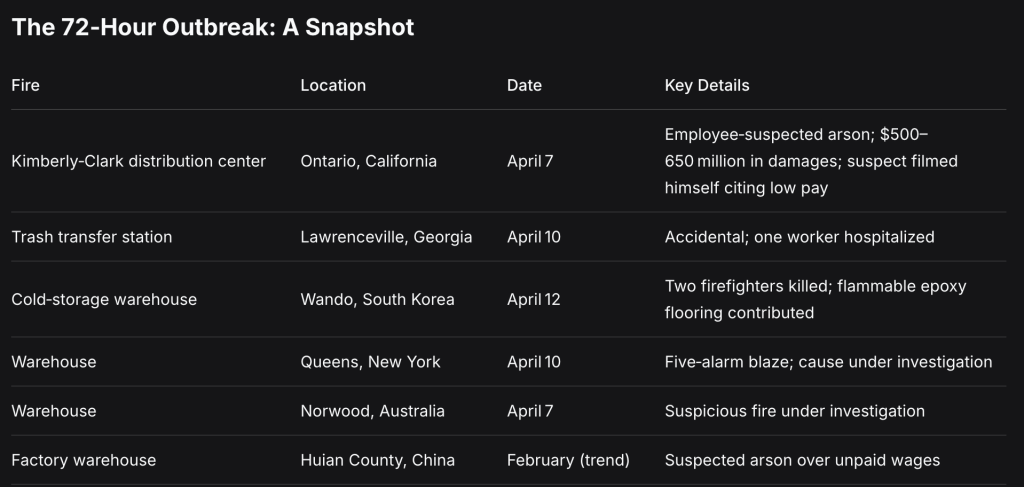
The sheer scale of destruction is staggering. The Ontario fire alone destroyed $500 million in paper products and $150 million in building value. More than 100 firefighters battled the blaze, and nearby residents were forced to evacuate as ash fell for miles. In South Korea, two firefighters, aged 44 and 30, were trapped and killed when an oil‑mist explosion occurred inside the warehouse. In Georgia, two workers suffered injuries while trying to escape a rapidly spreading trash‑pile fire.
The Ontario Fire: A Confession on Video
The Ontario case has become the most explicit link between low pay and workplace destruction. According to federal prosecutors, Chamel Abdulkarim—a 29‑year‑old employee of NFI Industries, a third‑party logistics provider—allegedly filmed himself igniting pallets of paper goods while repeatedly complaining about his wages. In the video, he says, “If you’re not going to pay us enough to live, at least pay us enough not to do this.” In text messages to a friend, he reportedly wrote, “I just cost these [expletive] billions. … All you had to do was pay us enough to live. Pay us more of the value WE bring. Not corporate.”
Abdulkarim also compared himself to Luigi Mangione, the man accused of murdering UnitedHealthcare’s CEO, and expressed anti‑capitalist views, claiming “not enough of the profits are being shared with workers.” Court records show he had previously sued a former employer for failing to provide legally required meal and rest breaks—a lawsuit that settled in early 2025.
“This form of ‘content‑driven sabotage’ is increasingly shaped by social media logic. Acts of destruction are no longer purely expressive—they are designed to be seen, shared, and amplified.”
The Structural Connection: Low Pay → High Risk
While the Ontario fire is an extreme case, it reflects a broader pattern. Research consistently shows that low‑wage warehouse workers face harsher conditions than their better‑paid counterparts—and that those conditions translate directly into safety risks.
1. Chronic understaffing and turnover. Warehouse turnover regularly exceeds 40 % in some regions, and operators rank labor scarcity as their single biggest operational risk. When workers are paid poverty wages, they leave—and those who remain are often overworked and undertrained. A 2025 report found that low‑wage workers are “far more likely to encounter dangerous or illegal conditions, like wage theft.”
2. Safety violations follow low pay. In 2025, OSHA settled 10 hazardous workplace cases involving Amazon warehouses, citing preventable injuries and ergonomic hazards. Similar patterns appear globally: a multi‑agency inspection in South Africa found workers locked inside factories, paid below minimum wage, and lacking basic safety equipment. In India, a warehouse fire that killed at least 25 people was later found to have “no fire safety features” and no approval from the state fire department.
3. Wage theft and unpaid overtime. FedEx faces a class‑action lawsuit in Minnesota over unpaid wages for security screenings and daily walks to timeclocks. In Turkey, 5,000 warehouse workers walked off the job at 12 Migros warehouses, demanding a 50 % wage increase and an end to subcontracting systems that hide actual pay. In Quebec, 550 Metro warehouse workers have been on strike since March 30, demanding a 20 % raise after six years of increases that lagged far behind inflation—while the company’s profits rose 39 % and its CEO got a 37 % pay raise.
4. Underpaid workers are less safe. Studies have found that “low‑wage workers are far more likely to encounter dangerous or illegal conditions.” Another analysis noted that “hazardous occupations are concentrated in low‑skill and low‑pay strata.” When workers are financially desperate, they are less likely to report safety violations, more likely to skip breaks, and more prone to fatigue‑related accidents.
The Invisible Cost of Payroll Arbitrage
Companies have long viewed low wages as a cost‑saving measure. The Ontario fire reveals the hidden cost of that strategy. As one business analysis concluded:
“When the gap between minimum wage and a livable income becomes too wide, it can create conditions of desperation that standard security systems cannot mitigate. Surveillance cameras, access controls, and internal protocols offer limited protection against insider threats driven by economic distress.”
The math is stark: increasing payrolls modestly is minimal compared to the potential losses from a single catastrophic insider event. The $650 million in damages from the Ontario fire alone could have paid a living‑wage increase for thousands of warehouse workers for years. Yet companies continue to squeeze labor costs, often treating wages as a purely financial variable rather than a security one.
Beyond Arson: The Rise of Labor Action
Not all responses to low pay are destructive. In fact, the past year has seen a wave of organized labor actions across the global warehouse industry:
- Turkey (January 2026): 5,000 Migros warehouse workers struck 12 facilities, demanding a 50 % wage increase and an end to tax‑dodging payroll practices.
- Quebec (March 2026 – ongoing): 550 Metro warehouse workers remain on strike, rejecting an 11 % raise over six years while the company’s profits soared.
- United Kingdom (March 2026): Tesco warehouse cleaners and caterers earning as little as £10.42 per hour struck over pay, working in a warehouse heated to only one degree Celsius.
- India (ongoing): Amazon warehouse workers in New Delhi protested for a monthly salary increase from 10,000 rupees ($120) to 25,000 rupees ($295).
- South Africa (2025–2026): Warehouse workers at a major distribution center have been picketing for over six months over wage disputes.
These actions demonstrate that underpaid workers are increasingly unwilling to accept the status quo. When collective bargaining fails, some workers turn to sabotage—and as social media amplifies those acts, the risk of copycat behavior grows.
The Future: Three Scenarios
If warehouse wages remain stagnant, the trend of fires and labor unrest will almost certainly accelerate. Here are three likely outcomes:
Scenario 1: More Insider Sabotage
As the Ontario case showed, a single disgruntled employee with access to a lighter can cause hundreds of millions in damage. The business press has already labeled this “content‑driven sabotage,” and experts warn that “acts of destruction are designed to be seen, shared, and amplified.” If wages do not rise, more workers may conclude that radical action is their only remaining leverage.
Scenario 2: Accelerated Automation
Companies may respond to labor instability by replacing humans with machines. Already, warehouse operators report that “skill shortages and turnover regularly exceeding 40 %” are driving investments in automation. In this scenario, low‑paid workers are not given raises—they are fired. The result would be even higher unemployment and social instability, but fewer on‑site employees to start fires.
Scenario 3: Regulatory Intervention
Several jurisdictions are already moving to protect warehouse workers. Virginia’s SB685 prohibits adverse action against workers for using bathroom facilities. Rhode Island’s Warehouse Worker Protection Act mandates quotas and safety standards. If fires continue, more aggressive regulations—including living‑wage mandates, mandatory safety audits, and criminal penalties for safety violations—could follow. In the Philippines, officials are already calling for criminal penalties for factory owners who violate safety standards after a deadly warehouse fire.
The Likeliest Path
The most probable future is a combination of all three: rising automation in high‑cost markets, continued labor unrest in low‑wage regions, and piecemeal regulatory responses that lag behind the crisis. The Ontario fire has already forced a rethinking of warehouse security. As one analysis put it:
“Industrial safety in the modern era is no longer limited to fire suppression systems or structural compliance. It now includes the economic and psychological conditions of the workforce inside those systems.”
Conclusion
The six warehouse fires in three days are not a random cluster of accidents. They are a symptom of a system that has squeezed labor costs to the breaking point. When workers cannot afford to live, they stop caring about their employers’ assets. Some strike. Some quit. And a few, like the man in Ontario, allegedly take a lighter to the building.
The Ontario fire caused $650 million in damage. But the real cost of low warehouse wages is far higher: lost lives, destroyed communities, disrupted supply chains, and a growing sense among workers that the system is rigged against them. Companies that continue to treat payroll as a purely financial variable ignore a basic truth: a worker who is paid a living wage is far less likely to burn down the building. The question is not whether wages will rise, but whether they will rise before the next fire.